Convenience vs. Security: How Beacon Intelligence Designs Secure Enterprise AI Agents
By
Tony Yum
Overview
In an ideal world, your LLM agent would know everything. You could ask it to update Jira, write and commit code, run unit tests, or even book a trade—all from a single prompt. That level of convenience is incredibly powerful. But in the world Beacon by Clearwateroperates in—financial institutions, large enterprises, and regulated environments—unrestricted power comes with real risk.
We designed our enterprise AI agent architecture around a simple question: how do we maximize convenience without compromising security?
Security by Default: Specialist AI Agents with Least Privilege
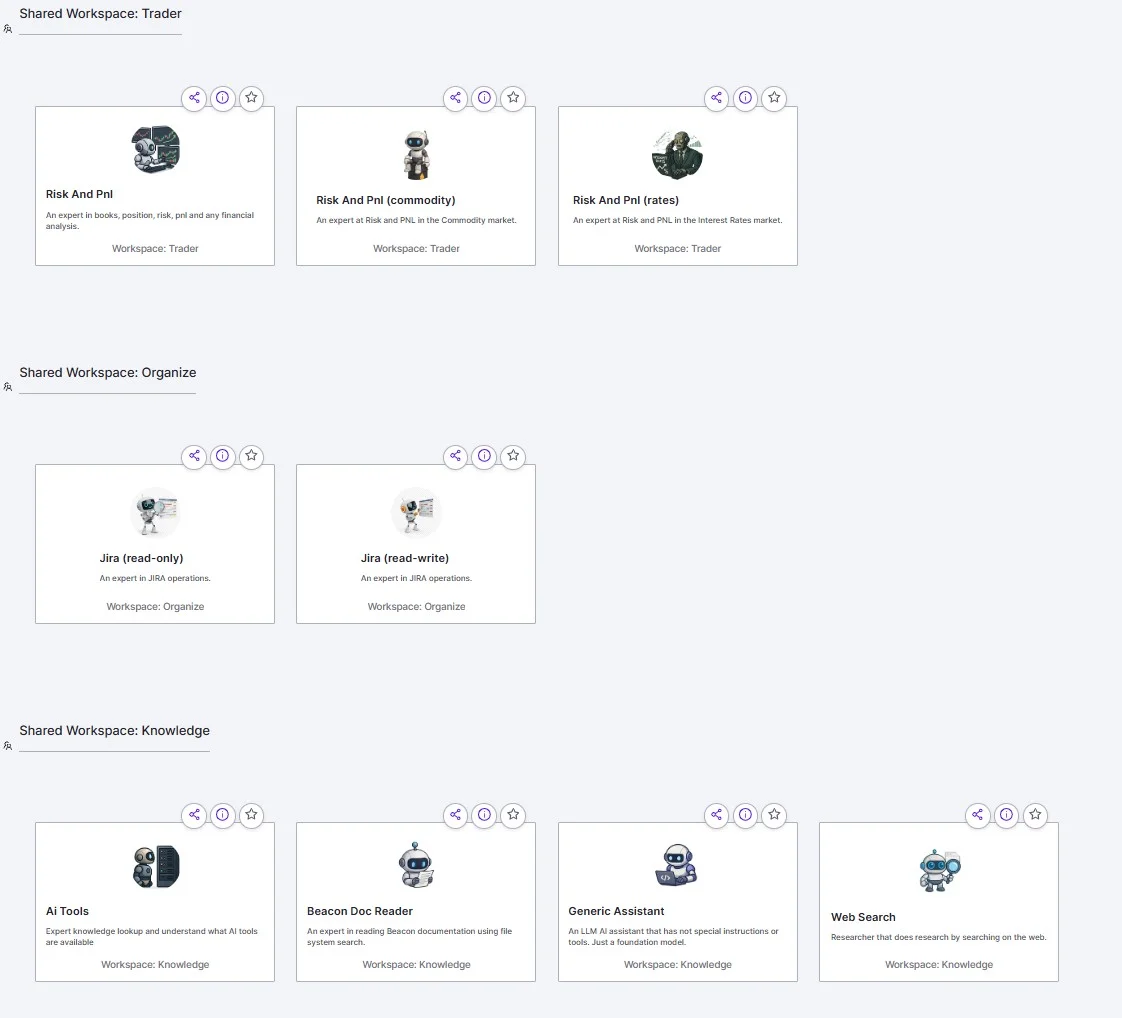
When you first open the Platform, you’ll notice a wide range of agents. These are specialist agents, each designed for a specific domain and equipped with a minimal, tightly scoped set of skills.
large
There might be a trading agent that can run real-time risk reports and value-at-risk (VaR) analytics, a coding agent that can write and test code, and another agent dedicated to operational tasks like updating Jira. This approach may feel “busy” at first, but it is intentional. By default, each agent only has the capabilities it absolutely needs—nothing more.
This bias toward least privilege is critical in enterprise and trading environments. It reduces blast radius, limits unintended actions, and makes AI agent behavior easier to reason about and audit.
The Receptionist Agent: One Entry Point, Intelligent Agent Routing
Of course, having many specialist agents raises a usability question: how does a user know which agent to talk to?
That’s where the receptionist agent comes in.
At the very top of the Platform’s front page, above all the individual agent choices, you’ll find a single prompt box. This is powered by the receptionist agent. You can ask anything in this box—no need to think about which agent is responsible.
The receptionist agent analyzes your request and routes it to the most appropriate specialist agent behind the scenes. Whether the task is trading-related, technical, or operational, the routing happens automatically. You get the simplicity of one input box, without giving up the safety of specialist agents operating within their boundaries.
Explicit Skill Expansion: Power with Intent
Sometimes, specialists need to grow.
Beacon by Clearwater allows users to explicitly add skills to an agent. This is a deliberate, user-driven action. If you want an agent to do more, you grant it more capability—clearly and transparently.
This design keeps control in the user’s hands. Agents don’t silently acquire new powers, and nothing happens implicitly. You decide when convenience outweighs additional security exposure.
The Meta Skill: Full Power, Opt-In
For users who want maximum flexibility and are comfortable with the trade-offs, Beacon offers a special capability: the meta skill.
An agent with the meta skill can discover any skill available on the platform and dynamically add it to itself. It also has reflective abilities—it knows what skills it currently has and can remove them when they’re no longer needed.
This is the “Matrix moment.” Like Neo waking up and saying, “I know jiu-jitsu,” the agent can instantly acquire new abilities on demand. It’s incredibly powerful—and intentionally not the default.
A Deliberate Spectrum: Balancing AI Agent Convenience and Security
By default, agents are tightly scoped and security-first.
When needed, users can explicitly expand an agent’s skills.
For maximum power, the meta skill unlocks full platform capability.
With the receptionist agent providing a single, simple entry point, users get ease of use without sacrificing safety. The result is a system that scales from conservative, enterprise-grade security all the way to highly autonomous, powerful agents—without forcing you to choose one extreme or the other.
At Clearwater, convenience is optional. Security is foundational.
If you are already a Beacon client, please reach out to your CS team to get started today.
If you are interested in learning more about Beacon Intelligence, connect with us here.
Frequently Asked Questions
What is Beacon’s approach to AI agent security?
Beacon follows a security-by-default model: every AI agent begins as a specialist with the least privilege it needs for its domain, and users explicitly grant additional skills only when required. This minimizes blast radius and keeps AI agent behavior auditable in regulated financial environments.
What are specialist agents in Beacon?
Specialist agents are domain-specific AI agents—such as a trading agent, a coding agent, or an operations agent—each equipped with a minimal, tightly scoped set of skills. This least-privilege design limits unintended actions and makes agent behavior easier to audit in enterprise and trading environments.
How does the receptionist agent work?
The receptionist agent is a single entry point that analyzes a user’s request and automatically routes it to the most appropriate specialist agent. Users get the simplicity of one prompt box while keeping the security boundaries of individual specialist agents intact.
What is the meta skill in Beacon?
The meta skill is an opt-in capability that lets an AI agent dynamically discover, add, and remove any skill available on the platform. It offers maximum flexibility for advanced users and is intentionally not enabled by default.
How does Beacon use AI agents for risk management?
Beacon’s trading and risk management platform uses specialist AI agents to run risk reports, value-at-risk (VaR) calculations, and other analytics within tightly scoped permissions. This least-privilege design lets financial institutions automate risk management workflows while keeping every action secure and auditable.
As markets speed up and uncertainties multiply, end-of-day risk reports no longer cut it. Risk management is now an ongoing dialogue throughout the day. Beacon AI agents are the first step from static analytics to interactive intelligence, adding a new voice to the risk conversation as AI grows into a holistic and collaborative approach with traders, quants, and analysts.
Effectively adding AI trading technology to your risk conversations requires more than just a single agent operating as your AI Assistant. An effective AI team is made up of a variety of specialized agents that work together, designed, controlled and orchestrated by their human leader to tackle the multi-step and multi-role activities that are part of real-life trading and portfolio management.