Introducing Beacon Intelligence AI Assistant: turning risk models into live conversations
As markets speed up and uncertainties multiply, end-of-day risk reports no longer cut it. Risk management is now an ongoing dialogue throughout the day. Beacon AI agents are the first step from static analytics to interactive intelligence, adding a new voice to the risk conversation as AI grows into a holistic and collaborative approach with traders, quants, and analysts.
At CWAN, AI is not a product or application, it is an embedded platform capability that works like a component of the platform’s operating system. Very important, all activity remains within each client’s cloud instance, with no leakage to CWAN or third-party LLM providers. Users can choose from three different interface points – a modern, intuitive screen for asking questions, embedded with the development environment, or accessible from the command line.
A squad of agents at your service
In this post, we’ll cover how our Beacon by CWAN embedded AI capabilities work, what they are , and also what they aren’t.
Instead of an immature chatbot, Beacon by CWAN has built a team of specialized and proactive agents that monitor risk and work like a squad of expert colleagues who are just a chat message or workflow assignment away.
Within Beacon, access to AI is through AI Assistant, which acts as a receptionist for the 30+ (and growing) embedded experts. For broader accessibility, the assistant is not buried within the development environment – it presents like any other search or query box. You can choose one of the specific agents to interact with or just type in your query and get routed to the appropriate one.
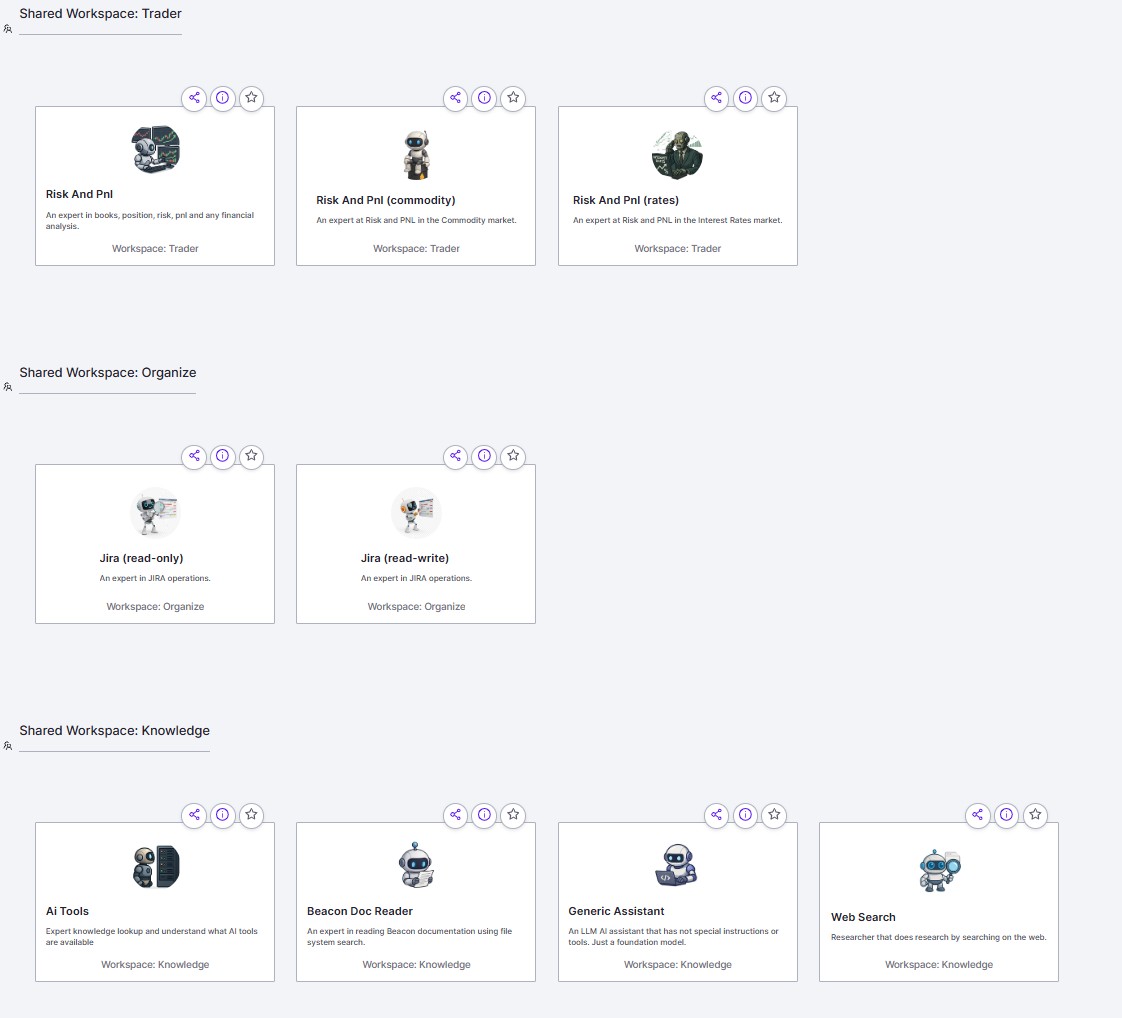
There are different categories of agents available out of the box, including developer, trader, knowledge, risk, quant, and organize. Beacon agents excel at collaboration, enabling you to share agents within a group workspace. Like other parts of Beacon, you can customize these agents to best suit your team and firm’s operations. Compute-heavy tasks can be assigned to run in the background on the platform’s cloud compute pools.
Secure foundations and convenient options
Beacon intelligence architecture is designed with three main parts: applications, agent models, and backend infrastructure.
The backend is a cluster of services for the agents to talk to, with an abstraction layer so that they are agnostic to any particular cloud provider. It’s important to note that this architecture delivers security by default. AI prompts are not logged, no data is leaked, used for training, or sent out to third-party providers. Tokens are retained within each customer’s instance and monitored for model selection and performance.
The agent models exist within a hierarchy, with the AI Assistant leading a group of specialized agent team members that can collaborate with each other but keep all code and data within the customer’s cloud. This boosts each agent’s effectiveness, making them experts within a specific domain of knowledge and a narrow skillset.
The applications are how users interact with the agents, whether in conversational mode through AI Assistant, as embedded code, or using Workflow Studio for zero-code agent creation. Token Monitor is used to track usage and set restriction polices.
For example, the trading agent can answer risk questions, the coding agent can write and test code, and the quant agent can assist with pricing models and analytics. This approach to AI is essential for fast-moving jobs and industries like ours, making responses easier to review, verify while limiting unintended actions or invalid responses.
Our biggest advantage is fully transparent and customizable code; customers can explicitly add skills to agents, or enable meta skills, which allow a selected agent to discover and add valuable adjacent skills or remove ones that are not needed.
How does this work in the real world?
Let’s start with Tony, a trader at a regional bank who needs help hedging a portfolio of natural gas holdings several times a week.
With a legacy system, he has to check current positions in a PDF, verifies that this correctly reflects the current position, determines the current delta exposure, figures out the necessary hedges, executes the trades, and then adds these back to the portfolio risk system. This currently takes 10 to15 minutes switching between three technology platforms.
With Beacon Trade Blotter, Tony spent 5-10 minutes switching between modules to finish these tasks.
With the power of Beacon’s AI agents, the process becomes much faster. In 10-20 seconds, these tasks are completed within one system.
Continue the AI conversation on your terms
Being a quant isn’t easy these days, in the face of complex assets, volatile markets, and demands for greater transparency. Traders need to react to markets in real time.
Analysts want to value complex assets while opportunities are still live. Portfolio managers demand instant visibility into exposures. And management sees AI as a game changer that will make everything faster and easier. Beacon’s AI agents provide a solid foundation to build on.
In our next post, we will talk about how to create your own agents based on your needs, with Workflow Studio.
If you are already a Beacon client, please reach out to your CS team to get started today.
If you are interested in learning more about Beacon Intelligence, connect with us here.