Connect Hong Kong: How AI is enhancing hedge fund workflows
Hedge funds are using AI to redefine how investment ideas move from idea to action and improve workflows.
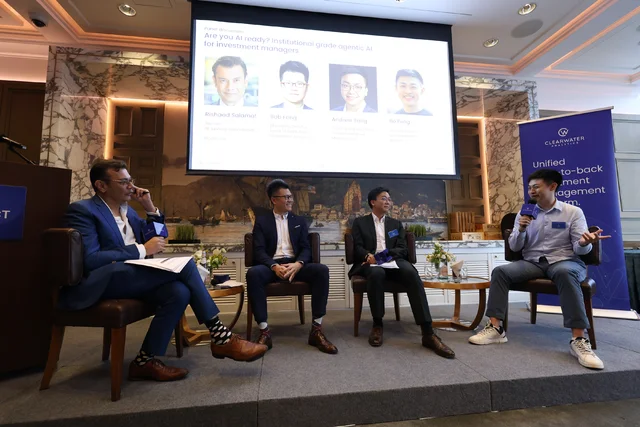
At a Connect Hong Kong panel discussion by Enfusion by Clearwater, a consistent message that came through was that the firms furthest ahead are asking which parts of their workflow are actually worth automating in the first place.
The panelists acknowledged that many firms are still stuck at the first step, comparing tools rather than examining the work those tools are meant to support.
“A lot of the questions that I hear people asking are: ‘Oh, are you using Gemini? What AI tools are you using? Are you using Claude?’” said one operations leader on the panel.
“But I think the more important question is, ‘What is our daily workflow right now? What’s the repeatable task? What is the human element that’s irreplaceable in the process?’
“I think we need to map it all out first before we can add an AI tool on top, because otherwise we’re not able to see visible or significant results.”
large
How AI in hedge funds can have many use cases
Not every firm is still at the mapping stage, though. While most are still working out how to fit AI into their operating models, a smaller group of early adopters have already moved past note-taking and meeting summaries into something more ambitious.
“Everyone knows you can use AI to take notes of your meetings, summarize them,” said another panelist. “But having worked with so many hedge funds and portfolio managers every single day, we’re seeing a lot of use cases develop.”
Take a question a portfolio manager might ask on an ordinary afternoon. What would happen if every individual short position were replaced with a single broad market hedge shorting the S&P 500 ETF, or the Nasdaq-100 ETF?
Not long ago, answering that would have meant pulling an analyst away from other work for a day or more. They would have needed to extract portfolio data, clean it, write scripts, and run risk calculations one at a time. Now, that same question can be typed into a natural-language prompt and answered in seconds, with AI handling the extraction, the scripting, and the scenario testing behind the scenes.
“So that’s one workflow,” the panelist continued. “Another might be [looking at] how my portfolio is performing right now, or if [a previous shock] happened again tomorrow, what would that mean for my portfolio. You can already do these [analyses] today, but AI saves you the clicks and the time, and you only really want to use AI if it saves you the time.”
The pattern reinforces a central argument. It is not the model answering the question that creates the advantage. It is the fact that the question can now be asked at all, on demand, without derailing someone’s day. The firms that benefit most are likely to be those that redesign how investment workflows through the organisation, rather than simply bolting another AI tool onto existing processes.
large
Why high-quality data helps improve AI workflows
But redesigning the workflow only gets a company halfway there. Behind every one of those instant answers sits a less glamorous requirement of data. Is it actually good enough to act on?
“The data is more important than the model itself… everyone is going to use the same model, but it’s going to drive different results,” another operations leader noted. “It’s the data – not just the depth of the data, but the breadth of the data – that will actually matter.”
Bob Feng, Head of APAC Sales at Clearwater Analytics, made a similar point. He said: “Competitive advantage is increasingly a function of proprietary, well-structured and traceable data, not access to any particular large language model.”
Speakers also reached the same conclusion at Clearwater’s Connect New York event. If data was not clean and well-structured, it became an obstacle to effective AI deployment.
large
AI is changing the competitive landscape for smaller firms
There is a further twist to this story, one that could unsettle the industry’s usual pecking order. AI has the potential to reshape competitive dynamics and not necessarily in favour of whoever already has the biggest budget.
Rather than simply reinforcing the advantages of the largest institutions, it could lower the barrier to entry for smaller and mid-sized firms by cutting the cost of building technology and automating operational tasks.
“I genuinely believe that AI is most valuable for small and medium-sized companies, not large companies,” said an investment leader.
For example, a smaller firm rather than paying hundreds of thousands of dollars for an enterprise customer relationship management system, a company could use AI to build a fit-for-purpose alternative for a fraction of the cost.
“It’s not just you ask a question and get back an answer. In the future, there will be several agents that are set up doing perhaps 50% of the workflows that you don’t like doing on a given day, and it will help automate a lot of those workflows.”
But for that future to arrive, firms will need to do far more than adopt the latest models. They will need to rethink how work is organised, ensure their data is accurate and accessible, and build the governance required to keep humans in control of increasingly automated processes.
That, the panel agreed, is where the real competitive advantage will come from.
If you would like to learn more about the topics covered or see how Enfusion by Clearwater can support your workflow, we’d be glad to connect.
Clearwater is building a single, audit-ready, front-to-back platform designed for the complexity that institutional investors face today. By bringing together critical capabilities across the investment lifecycle, we are making it easier for firms to deliver clearer recommendations, operate with greater confidence, and support clients with a more connected view of their business.
A deep dive into Clearwater’s performance and risk reporting capabilities, designed to help you better understand results, identify trends, and proactively manage portfolio exposure.
A focused session on Clearwater’s compliance capabilities, built to help teams confidently monitor policies, identify issues early, and reduce the manual burden of ongoing compliance management.